
WhatsApp's Free Window Closed on 1 October 2026: What It Costs You Now
Service messages and in-window utility templates stopped being free on 1 October 2026. Inbound support setups took the biggest proportional hit. Here's how to work out your new bill and what to change now.

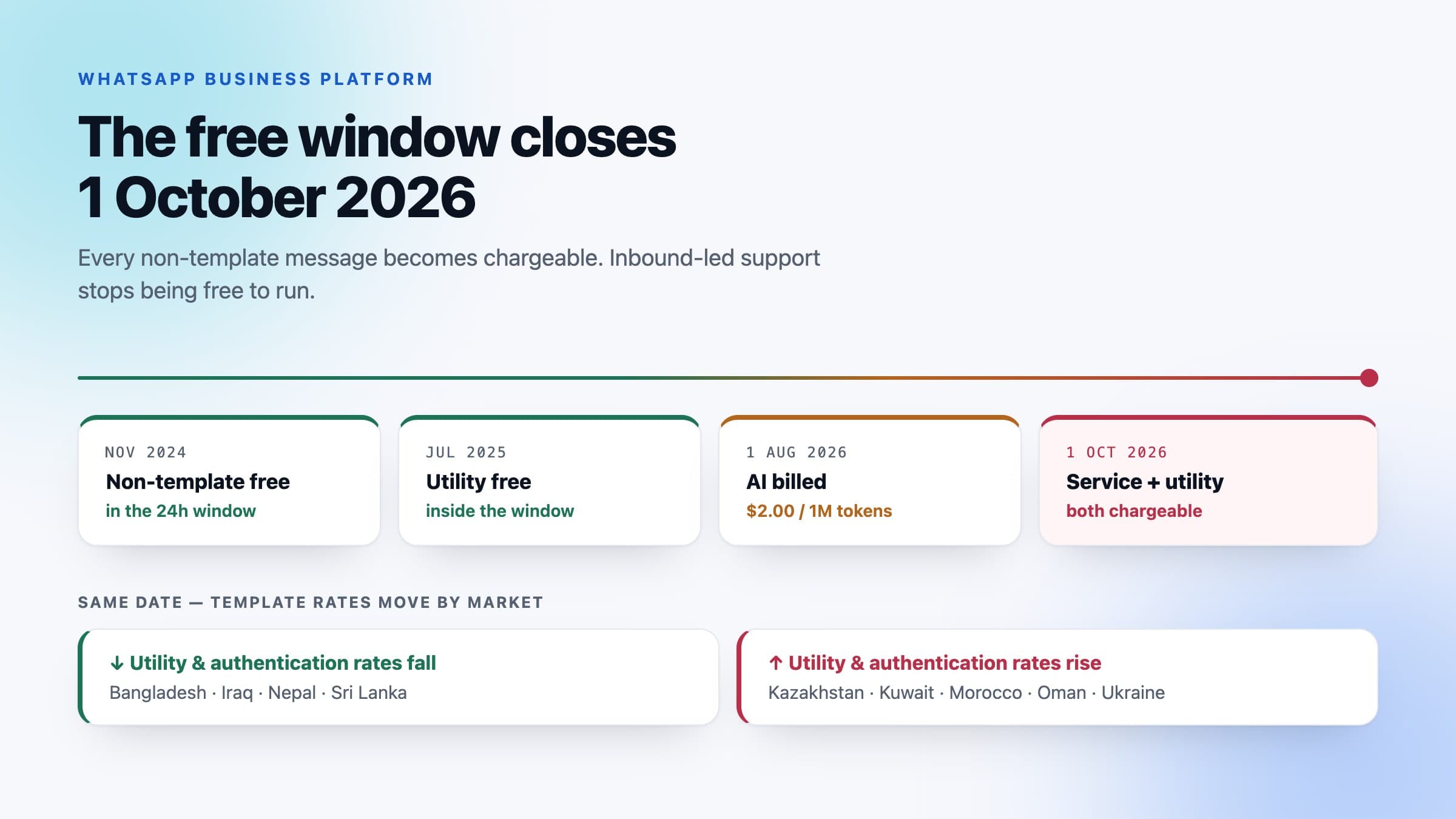
If you run WhatsApp support, the cheapest part of your setup has stopped being free. On 1 October 2026, Meta began charging for messages that had cost nothing since November 2024, and the architecture most teams were told to build — get the customer to message first, then handle everything inside the 24-hour window — lost the thing that made it cheap.
We build on the WhatsApp Business Platform for clients across Pakistan and the Gulf, so we've been modelling this with them since the notices went up. This is what changed, what it does to a real monthly bill, and the four things worth doing now that it is live.
Updated after the change took effect. The deadline in the headline has passed — if you have not re-modelled your messaging line yet, the numbers below are now describing your current invoice rather than a future one.
What changed on 1 October 2026
Meta's own wording is blunt: any non-template message is charged as of October 1, 2026. Two categories that were free lost that status on the same day.
- Service messages. Free since 1 November 2024. These are the plain replies a human agent types inside an open customer service window — no template, no approval, no charge. They are now billed at rates benchmarked against utility and authentication templates in each market.
- Utility templates inside an open window. Free since 1 July 2025, when per-message pricing replaced the old conversation model. Order confirmations, delivery updates, appointment reminders sent while the window was open cost nothing. They are now charged.
There's a third change already in effect: since 1 August 2026, replies generated by Meta's own Business Agent are billed on token consumption rather than per message, at roughly $2.00 per million tokens. That one is genuinely cheap for a typical exchange, and it's the only part of this that got better.
Read it from the source rather than from a summary — including ours. Meta documents the mechanics under non-template message pricing, and the current per-message model under pricing. This part of the platform has changed three times in two years, so anything you read with a 2025 dateline is worth re-checking.
Why this hits support teams hardest
Here's the uncomfortable bit. The businesses most exposed are the ones that took the advice everyone was giving, including ours.
Under per-message pricing, the standard guidance since July 2025 has been to design for inbound: let the customer open the conversation, then do as much as possible inside the 24-hour window where messages are free. That advice was correct. It produced support setups where a hundred conversations a day cost effectively nothing in messaging fees, and the only real spend was the build.
Those are exactly the setups whose messaging line went from near-zero to a real number on 1 October. An outbound marketing operation, by contrast, was already paying full marketing rates on every send. It barely notices.
So the rough shape of the impact:
| Your setup | What it cost before 1 October | What it costs now |
|---|---|---|
| Inbound support, humans answering in-window | Effectively zero messaging spend | Every agent reply is billable. Largest proportional increase. |
| Order status and delivery updates via utility templates | Free while the window is open | Charged at the utility rate for the recipient's market. |
| Lead qualification, customer-initiated | Low — mostly in-window | Moderate increase, scaling with how chatty the qualification flow is. |
| Outbound marketing campaigns | Already paying full marketing rates | Broadly unchanged. No volume tiering on marketing either way. |
If your monthly WhatsApp invoice has been suspiciously small, that's not a discount you negotiated. It was a subsidy with an end date, and the date has passed.
Rates moved by market on the same date
Buried in the same set of changes is a market-by-market rate adjustment for utility and authentication templates. It's not uniform, and it matters for anyone messaging across borders.
- Rates fell in Bangladesh, Iraq, Nepal, and Sri Lanka.
- Rates rose in Kazakhstan, Kuwait, Morocco, Oman, and Ukraine.
For our own client base that's a mixed result. A Karachi business messaging customers in the Gulf saw Kuwait and Oman get more expensive on exactly the day in-window utility stopped being free — two increases landing together. A company serving Bangladesh or Sri Lanka got a partial offset.
Pull your actual numbers from Meta's pricing page, which lets you select market, currency, and category. We deliberately don't publish rate tables — they go stale within months, which is precisely how the industry ended up full of guides still quoting the deprecated per-conversation model.
How to work out what it is actually costing you
You don't need a model. You need last month's message log and about twenty minutes. Most BSP dashboards (Twilio, 360dialog, Infobip) will export this, and Cloud API users can pull it from their own logs.
- Count non-template messages sent by your side. Every plain-text agent reply, every image, every quick answer inside an open window. This is the number that went from free to billed. In most support setups it is much bigger than people expect — a single resolved conversation is rarely one message.
- Count utility templates sent inside an open window. Separate these from utility templates sent outside a window, which you're already paying for.
- Split both counts by recipient country. Rates are per market, and the October adjustments cut both ways.
- Price them at your market's utility rate. Meta benchmarks the new service message rates against utility and authentication templates, so the utility rate is the right first approximation.
- Add it to your current invoice. That's your current run-rate, before any of the fixes below.
The number that tends to shock people isn't the rate. It's the message count. A support conversation that felt like "one interaction" is often eight or nine outbound messages once you count the greeting, the clarifying question, the answer, the follow-up, and the sign-off.
Four things worth doing now
1. Cut message count, not conversation quality
This is the highest-value change and the one nobody wants to hear, because it means editing the flows you just built. When every outbound message is billable, a flow that sends three messages where one would do is now three times the cost.
The usual offenders: a greeting message that says nothing, a "let me check that for you" filler, splitting one answer across several bubbles because it reads better. Consolidate them. Send fewer, better messages. Your customers will not miss the filler — in our experience they prefer the tighter version.
An interactive list or button reply that resolves an intent in one exchange beats a chatty five-message clarification loop on both cost and customer experience. That was true before October. It's just now measurable.
2. Resolve more without a human typing
If a question has a deterministic answer — order status, opening hours, "where's my delivery" — it shouldn't reach an agent at all. Rule-based flows resolve those in a fixed, predictable number of messages, and the routing logic itself costs nothing.
The trap is over-correcting into a bot that frustrates everyone to save a few cents. The split is worth getting right; we go through it in rule-based or AI, and how to decide which handles what.
3. Reprice anything that depended on this being free
If you sell WhatsApp support as part of a service, a retainer, or a subscription, check whether your margin quietly assumed zero messaging cost. Some of the packages we've reviewed this year were priced in 2025 against a cost line that no longer exists. Better to reprice deliberately than to discover it in this month's invoice.
4. Make sure you can actually see the cost
A surprising number of businesses can't answer "what did WhatsApp cost us last month, by conversation type?" If your BSP dashboard doesn't break spend down by category and market, you'll find out about a problem a month after it starts. If you did not set this up before 1 October, the clean before-and-after is already gone — which is an argument for starting the baseline today rather than after the next surprise.
What not to do
Don't abandon the channel. The increase is real, but WhatsApp remains dramatically cheaper per resolved conversation than phone support, and customers in Pakistan and the Gulf overwhelmingly prefer it. Going from "free" to "a few cents" is not the same as going from cheap to expensive.
Don't panic-migrate to the API if you're on the free app. This change affects the Business Platform (API). The free WhatsApp Business app has no per-message charges of any kind, and for a small team with no system integration it stays a perfectly reasonable answer. If anything, the change makes the case for staying put slightly stronger. We compare the two in WhatsApp Business app vs API.
Don't buy an "October 2026 compliance" package. There's nothing to comply with. This is a pricing change, not a policy change. Anyone selling urgency around it is selling urgency.
The honest summary
The free window was always going to close. Meta subsidised in-window messaging to get businesses building on the platform, and that phase has ended on a published schedule with plenty of notice — which is more than most platforms give.
What it changes is the design principle. Since July 2025, the goal was get the conversation started by the customer. Since 1 October 2026, it is resolve it in fewer messages. Teams whose flows were built around free in-window messaging need to edit them. Teams that were already disciplined about message count will barely notice.
Want to know what this actually does to your bill? Send us last month's message counts split by direction and country, and we'll model it against your markets — no obligation, and if the answer is "you're fine, change nothing", that's what we'll tell you. You can also read what WhatsApp automation actually costs to build and run, or see how we approach WhatsApp and Messenger work.
Frequently asked questions
What changes for WhatsApp Business pricing on 1 October 2026?
Two things that were free become chargeable. Service messages, meaning the non-template replies a human agent types inside the 24-hour customer service window, have been free since 1 November 2024 and will be billed at rates benchmarked against utility and authentication templates. Utility templates sent inside an open window, free since 1 July 2025, are also charged. Meta's documentation states plainly that any non-template message is charged as of October 1, 2026.
Which businesses are hit hardest by the October 2026 change?
Inbound support operations, which is the uncomfortable part, because that is the architecture the platform has encouraged since per-message pricing arrived. If customers message you first and your team answers inside the 24-hour window, your messaging spend today is close to zero and every one of those replies becomes billable. Outbound marketing operations barely notice, because they were already paying full marketing rates on every send.
How do I estimate my new WhatsApp bill?
Export last month's message log and count two things: non-template messages your side sent, and utility templates sent inside an open window. Split both by recipient country, price them at that market's utility rate, and add the result to your current invoice. The rate is rarely what surprises people. The message count is, because a single resolved conversation is usually eight or nine outbound messages rather than one.
Are WhatsApp template rates changing by country too?
Yes, on the same date and not uniformly. Utility and authentication rates fall in Bangladesh, Iraq, Nepal and Sri Lanka, and rise in Kazakhstan, Kuwait, Morocco, Oman and Ukraine. Businesses messaging into the Gulf therefore see two increases land together. Pull current numbers from Meta's official pricing page by market and category rather than from any rate table published in an article.
Does this affect the free WhatsApp Business app?
No. This is a WhatsApp Business Platform (API) pricing change. The free Business app has no per-message charges of any kind and is unaffected. If anything, October 2026 slightly strengthens the case for small teams with no system integration to stay on the free app rather than moving to the API.
What should I actually change before October 2026?
Cut message count without cutting quality, since every outbound message is now billable: consolidate greetings, filler and multi-bubble answers, and prefer interactive lists or buttons that resolve an intent in one exchange. Route deterministic questions to rule-based flows so an agent never types them. Reprice any service or retainer whose margin assumed zero messaging cost. And make sure your dashboard breaks spend down by category and market before the change, so you have a clean before-and-after.
Related Posts
How Much Does WhatsApp Automation Cost in 2026?
Meta moved to per-message pricing in July 2025 and most quotes still haven't caught up. What WhatsApp automation actually costs to build and run, and which parts you control.
WhatsApp Business App vs API: Which You Actually Need
Every article ranking for this question was written by a company that sells the API, and two of the facts they all repeat are wrong. Here's the vendor-neutral answer.
The 5-Minute Rule Isn't From Harvard, and the Detail Everyone Drops Is the Useful One
21x more likely to qualify at five minutes than thirty. The number is real, the attribution is wrong, and the shape of the curve — not the speed — is what tells you how much engineering the problem deserves.