
AI or Rule-Based Chatbot? The Answer Is Which Question You're Answering
Everyone says "hybrid" and stops there. The useful part is deciding which questions go down which path — and the two technologies fail in completely different ways.

Search this and every result on the first page is a chatbot platform. They all reach the same conclusion — you want a hybrid — and then the article ends, because the interesting part is the bit that sells nothing: which questions go down which path, and who decides.
We build both kinds. We've also replaced a fair number of AI assistants with rule-based flows, which is not the direction anyone expects. Here's how the decision actually gets made on a real project.
What each one actually is
The naming is unhelpful, so let's be precise.
A rule-based bot follows a decision tree you wrote. Menus, buttons, keyword matches, branches. Given the same input it produces the same output, every time. It cannot say anything you didn't write.
An AI assistant — in practice, an LLM with retrieval over your content — interprets what someone meant and composes an answer. Given the same input it produces a similar answer, not an identical one. It can say things you didn't write, which is simultaneously the entire point and the entire risk.
The important difference isn't intelligence. It's determinism. One is a program. The other is a probability distribution with good manners. That single property drives everything below.
The question that settles it
Not "how advanced do we want to be?" This one:
Does this question have exactly one correct answer that you already know?
If yes, rules win. "Where is order 4471?" has one right answer, and it's in your database. Using a language model to fetch it adds latency, cost, and a non-zero chance of a confidently wrong number. A lookup and a template answer it perfectly, forever, at no marginal cost.
If no, rules lose badly. "I ordered the wrong size and I'm travelling next week, what are my options?" has no single correct answer. It has an intent buried in context. A decision tree meets that with a menu, and the customer picks the closest wrong option or gives up.
Everything else is detail.
Where each one fails, specifically
Both fail. They fail differently, and the difference matters more than the capability comparison.
Rule-based failure: the dead end
The customer's situation isn't on the menu. They type something the keyword matcher doesn't recognise. The bot repeats the menu. They type it differently. It repeats the menu again.
This failure is visible and immediate — everyone knows it went wrong, including the customer. It's infuriating, it damages the brand, and it's the reason "chatbot" is a slur in some markets. But nobody is misled. And it's cheap to fix: you add the missing branch.
AI failure: the confident wrong answer
The customer asks about your returns policy. The model produces a fluent, plausible, well-formatted answer describing a policy you don't have. The customer believes it, acts on it, and turns up expecting a refund you never offered.
This failure is invisible at the point it happens. Nobody flags it. You find out in a complaint, or in a consumer-protection dispute where "our bot said it" is not a strong position. It is fixable — grounding, retrieval, evaluation — but it's ongoing work, not a one-time correction.
So the honest framing: rules fail loudly and cheaply, AI fails quietly and expensively. Choose which failure mode you can live with on each type of question, and you've essentially designed the system.
The routing design that actually works
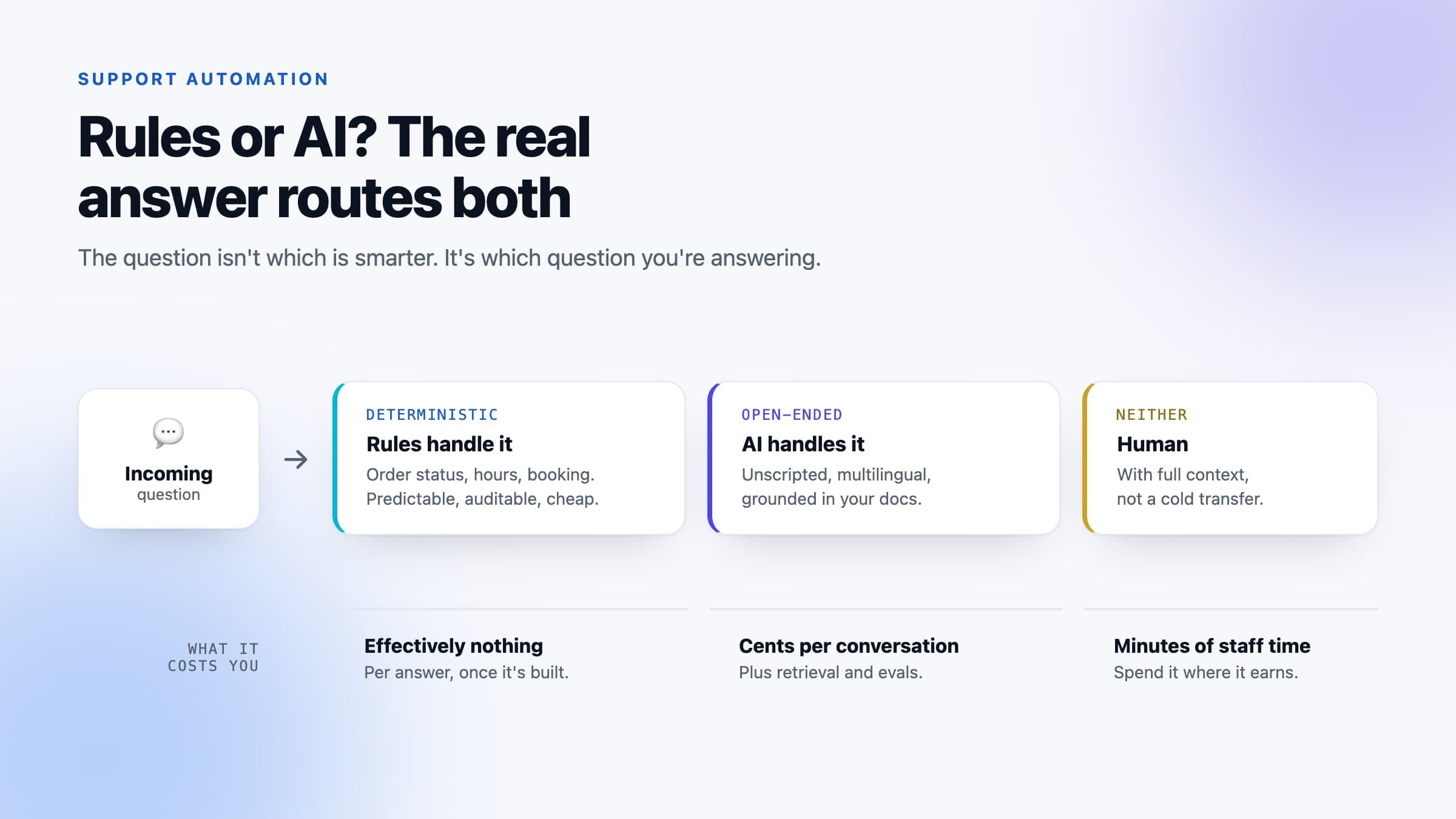
Every serious deployment we've built has the same three-way shape. The value is in the routing, not in either component.
Path 1: deterministic questions → rules
Order status, opening hours, branch locations, booking a slot, payment links, "am I eligible". Anything with a database answer or a fixed policy. Handled by a lookup and a written response.
Predictable, auditable, instant, and free to run. Route as much volume here as you can — in most businesses it's 50–70% of inbound, because customers ask the same handful of things constantly.
Path 2: open-ended questions → AI, grounded
Product comparisons, "does this work with my setup", multi-part questions, anything phrased in a way you didn't anticipate, anything in a language you didn't script for. Multilingual handling is where AI earns its place outright: for markets where customers write in Urdu, Roman Urdu, Arabic, and English interchangeably — often in one message — writing keyword rules for that is not a real plan.
Two non-negotiables on this path. The model answers only from your retrieved content, never from what it happens to know. And it must be able to say "I don't know, let me get someone" — a model with no exit produces its worst answers when it's most out of its depth.
Path 3: neither → a human, with context
Complaints, anything with money at stake, anything emotionally charged, anything where being wrong is expensive. Route immediately and carry the transcript across.
This path is the one that gets neglected, and it's the one customers judge you on. A handover that makes someone repeat everything they just typed is worse than no bot at all — you've added a step and lost the context. Get this right before you tune anything else.
How to decide, in the order that works
Don't start from the technology. Start from the transcripts.
- Export the last 500 real conversations. Not what you imagine customers ask. What they actually asked, in their words, typos included.
- Sort them into the three paths above. One correct known answer, open-ended, or must-be-human. An afternoon of manual sorting will tell you more than any vendor demo.
- Look at the split. If 70% land in path one, build the rules first and ship them. You'll capture most of the value in weeks, and you'll have a working baseline before you spend anything on a model.
- Check whether path two justifies itself. If open-ended questions are 10% of volume and your customers all write in one language, an LLM may be solving a problem you don't have. If they're 40%, or arriving in four languages, it isn't optional.
- Build path three first anyway. Handover is the safety net under both other paths. If it doesn't work, nothing else should ship.
The order matters. Teams that start with the model spend months on the hard 20% while the easy 70% goes unhandled. Teams that start with rules ship something useful quickly and learn exactly where the rules run out — which is the requirements document for the AI layer, written by real customers instead of by a workshop.
Three things that decide it for you
Sometimes the choice isn't yours.
- Regulated answers. Financial, medical, legal, or anything where a wrong answer is a liability rather than an inconvenience. Fixed, approved wording, delivered deterministically. Don't let a model paraphrase a compliance-approved sentence.
- No content to ground on. Retrieval-based AI is only as good as what it retrieves. If your policies live in three people's heads and a 2021 PDF, an LLM will improvise — and improvisation is exactly the failure mode you're trying to avoid. Fix the content first; it's cheaper than fixing the bot.
- Nobody will own it. An AI assistant is a system that needs monitoring, evaluation, and correction as your products change. If there's no one whose job includes reading transcripts monthly, build rules. Rules degrade gracefully when neglected. AI does not.
What "hybrid" should mean in your scope document
Everyone agrees on hybrid, so the word has stopped carrying information. When you're specifying a build, insist on answers to these:
- What classifies an incoming message into a path? A keyword list, an intent classifier, or the model itself? Each has different failure characteristics — and if the classifier is the model, your "deterministic" path isn't.
- What does the AI path retrieve from, and who keeps it current? Name the source and name the person.
- What triggers escalation to a human, and what does the human receive? Full transcript, or a summary that drops the detail that mattered?
- How do you know it's still right in six months? Evaluation sets, transcript review, or hope. Only two of those are answers.
A vendor who can answer all four is building a system. One who answers "our AI handles it intelligently" is selling a demo.
The short version
- One known correct answer? Rules. Cheaper, faster, auditable, and it can't invent anything.
- Open-ended, unscripted, or multilingual? AI — grounded strictly in your content, with a clear way to say "I don't know".
- Money, complaints, or emotion involved? A human, with the whole transcript already in front of them.
- Start with your transcripts, not with a platform. The split in your own data tells you what to build and in what order.
Want a straight answer for your case? Send us a few hundred real conversations, or just describe the ten questions you get most. We'll tell you what share is genuinely rule-shaped — and if the answer is that you don't need an LLM at all, that's what we'll say. See how we approach AI assistant work, or read what an AI assistant actually costs to build and run. If the channel is WhatsApp, the October 2026 pricing change changes the maths on message count too.
Frequently asked questions
Should I use an AI chatbot or a rule-based one?
Ask whether the question has exactly one correct answer that you already know. If it does, rules win: a lookup and a template answer it perfectly, forever, at no marginal cost, and cannot invent anything. If it does not, rules fail badly, because a decision tree meets an unanticipated situation with a menu and the customer picks the closest wrong option or gives up. Most businesses need both, split by that test.
How do AI and rule-based chatbots fail differently?
Rule-based bots fail loudly and cheaply. The customer's situation is not on the menu, the bot repeats itself, everyone knows it went wrong, and you fix it by adding the missing branch. AI assistants fail quietly and expensively, producing a fluent and plausible answer describing a policy you do not have. Nobody flags it at the time and you find out in a complaint. Choose which failure mode you can live with per question type and you have essentially designed the system.
What does a hybrid chatbot architecture actually look like?
Three paths. Deterministic questions such as order status, opening hours and booking go to rule-based flows, which is typically 50 to 70 percent of inbound volume. Open-ended, unscripted or multilingual questions go to an AI layer grounded strictly in your retrieved content, with a clear way to say it does not know. Anything involving money, complaints or emotion goes straight to a human with the full transcript already in front of them.
How do I decide what my chatbot should handle?
Start from transcripts rather than from a platform demo. Export the last 500 real conversations, sort them into deterministic, open-ended and must-be-human, and look at the split. If most land in the deterministic bucket, build the rules first and ship them in weeks. Where the rules run out is your requirements document for the AI layer, written by real customers instead of by a workshop.
When is an AI chatbot the wrong choice?
Three situations decide it for you. Regulated answers in finance, medicine or law need fixed approved wording delivered deterministically, not paraphrased by a model. If your policies live in three people's heads and an old PDF there is nothing to ground on, and the model will improvise, which is the failure mode you are trying to avoid. And if nobody's job includes reading transcripts monthly, build rules, because rules degrade gracefully when neglected and AI does not.
Do I need AI for multilingual customer support?
This is where AI earns its place most clearly. In markets where customers write in Urdu, Roman Urdu, Arabic and English interchangeably, often within a single message, writing keyword rules to cover that is not a realistic plan. Deterministic lookups still handle order status in any language once the intent is identified, but the interpretation layer is genuinely hard to do with rules alone.
Related Posts
AI Phone Agents: What They Can Actually Handle, What a Minute Costs, and the 200ms Problem
Human turn-taking runs at 0–200 ms; the best agents manage 500. A well-built minute costs three to seven cents before margin. Gartner says cost per resolution passes $3 by 2030. What to let it answer, what never to, and how we build one.
AI Agent Cost Per Task: Why Your Bill Is a Reliability Problem
Token cost grows with the square of the steps, the chance of needing another attempt grows exponentially with them, and the human who cleans up afterwards costs more than both. Here is the model we use to decide whether an agent is viable, with the arithmetic shown.
What an AI Chatbot Actually Costs to Build and Run
Model tokens are usually the smallest line on the invoice. Here's the real breakdown of build, running, and maintenance costs, with current model pricing and honest deflection rates.