
The 5-Minute Rule Isn't From Harvard, and the Detail Everyone Drops Is the Useful One
21x more likely to qualify at five minutes than thirty. The number is real, the attribution is wrong, and the shape of the curve — not the speed — is what tells you how much engineering the problem deserves.

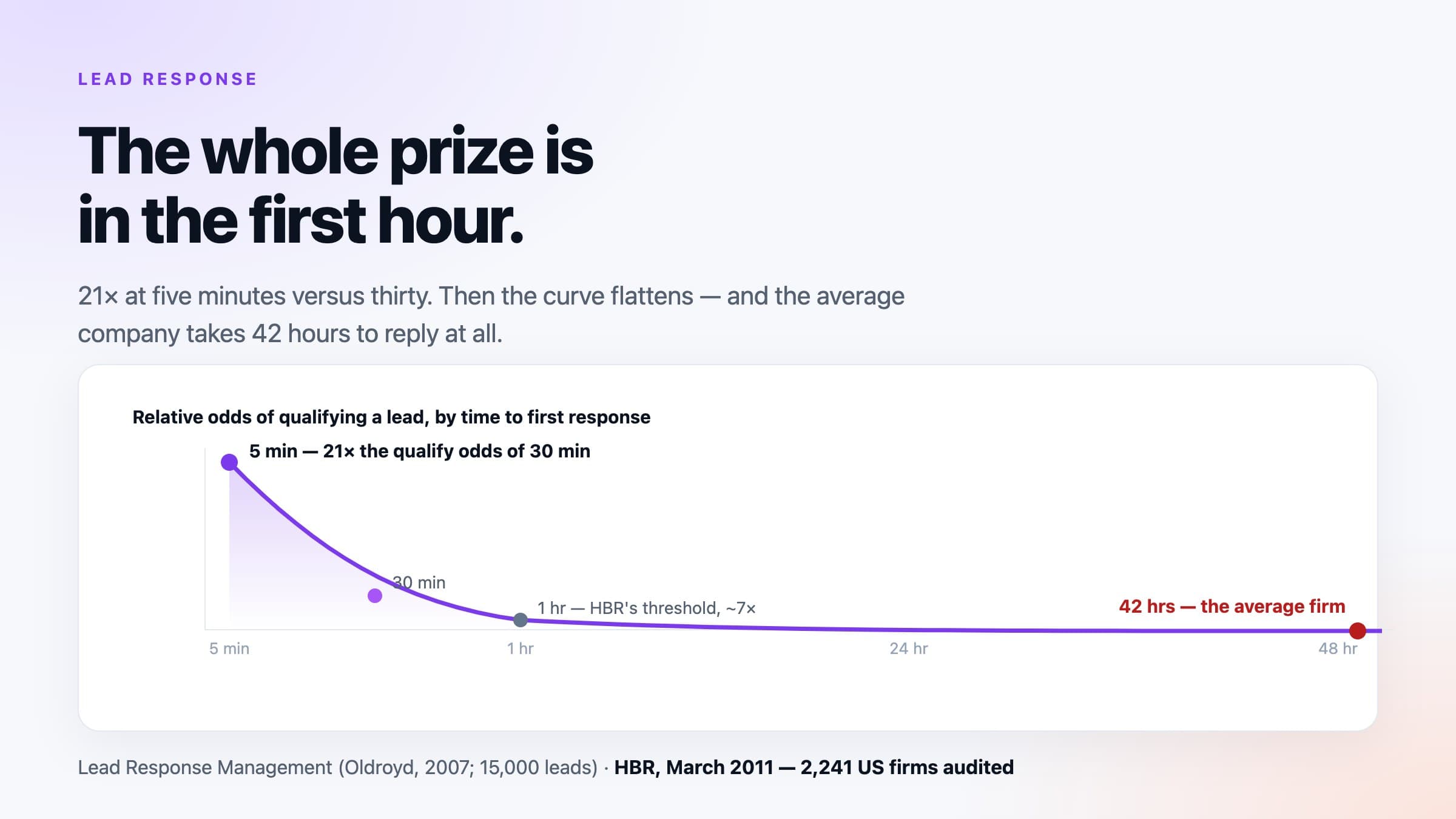
There's a statistic you've almost certainly seen: respond to a lead within five minutes and you're 21 times more likely to qualify it than if you wait thirty. It's on every CRM vendor's site, in every sales deck, and it is usually credited to Harvard Business Review.
The number is real. The attribution is wrong, and the detail everyone drops is the part that would actually change what you build.
I want to go through what the research says properly, because "be faster" is useless advice — every business already wants to be faster — and because the interesting finding is not that speed wins. It's where the curve falls off, which tells you exactly how much engineering the problem deserves.
The two studies, correctly attributed
The 21× figure comes from the Lead Response Management study led by Dr James Oldroyd, first circulated in 2007, working with InsideSales.com on data from six companies: roughly 15,000 leads and over 100,000 call attempts. Measured against response time, the odds of qualifying a lead were about 21 times higher at five minutes than at thirty. The odds of simply making contact were about 100 times higher.
The Harvard Business Review piece is a different and later study. In March 2011, Oldroyd, Kristina McElheran and David Elkington published The Short Life of Online Sales Leads, in which they audited 2,241 US companies by submitting test enquiries through their websites and timing the first response. The finding that matters: firms responding within an hour were around seven times likelier to qualify the lead than those responding even an hour later. And the average first response time across those 2,241 companies was 42 hours.
Cite the 2011 audit for how badly companies do, and the 2007 study for the shape of the decay. They are related but not the same thing, and the people who merge them tend to lose the shape — which is the only part that tells you what to build.
The shape is what matters
If response quality decayed linearly, this would be a staffing problem: hire more people, answer faster, improve proportionally. It doesn't. It collapses early and then flattens, which makes it an engineering problem with a very specific boundary.
Read what that shape implies. The difference between five minutes and an hour is enormous. The difference between a day and a week is almost nothing. So the only intervention worth paying for is the one that moves you from "hours" into "minutes" — and past about an hour, spending more to be somewhat faster buys you very little.
That is a narrow, buildable target, and it is why this problem is worth automating rather than staffing. You do not need to answer every enquiry in five minutes with a human. You need the first response inside a few minutes, and the human conversation can follow at human speed.
Why the 42 hours happens
No business intends to take two days. It happens structurally, and in the same four ways almost everywhere we've looked:
- The form goes to an inbox. A shared inbox is not a queue. It has no owner, no timer and no escalation, and at 4:55pm on a Friday it has no one.
- Enquiries arrive where nobody is watching. The website form is monitored. The WhatsApp number, the Instagram DM, the number on the van and the email address on an old brochure are not, and for most local businesses they carry more volume than the form.
- Qualification is treated as a prerequisite. Someone decides they need to understand the enquiry before replying, so the reply waits for the understanding. Reversing that single assumption — acknowledge now, qualify next — recovers most of the loss.
- Nights and weekends. An enquiry at 7pm Friday is a Monday-morning enquiry, which is 62 hours. Two competitors replied on Saturday.
Notice that none of these are effort problems. Every one is a routing problem, and routing is exactly what software is good at.
What "responding in five minutes" should actually mean
Here's where most automation projects go wrong. They read the research, conclude that speed wins, and deploy a bot that replies instantly with something worthless — "Thanks for your enquiry! A member of our team will be in touch." That is not a five-minute response. The clock the research measures is the clock until the prospect feels attended to, and a template acknowledgement doesn't stop it.
A response that counts does four things inside those minutes:
- Confirms what they asked about, in their words. "You're after a quote for a three-bedroom rewire in Clifton" proves a system read the enquiry rather than logged it.
- Answers the obvious next question — the one they were going to ask anyway. Price band, whether you cover their area, whether you handle their insurer, how soon you could start.
- Offers the next step concretely. Two real slots from a live calendar, not "when suits you?". The worst thing an instant reply can do is hand the work back.
- Says what happens next and when, and then that actually happens. A promise of "within the hour" that lands in ninety minutes is worse than no promise.
Everything in that list needs a system of record behind it — the calendar, the coverage rules, the price bands. Which is the real reason this is an integration problem rather than a chatbot problem, and why the version that works is usually less clever than the demo and far more connected.
What to do with the enquiry you can't answer
Some enquiries should not get an automated answer at all: a complaint, a claim, anything with a symptom in it, anything where a wrong number creates a liability. The instinct is to route those to a human and let the timer run, which throws away the finding.
The better pattern is to split the two things the research conflates. Acknowledgement is instant and automated. Resolution is human and can take as long as it takes. So: confirm receipt with the specifics, tell them a named person is picking it up, give a genuine time, and escalate with the transcript attached so that person isn't starting from nothing. You've stopped the clock without pretending to answer something you shouldn't.
We build this as a five-stage pipeline — Capture, Understand, Act, Escalate, Report — precisely so the escalate stage is designed rather than accidental. The failure mode of every fast-response project is that the handover is an afterthought and the prospect tells their story twice.
Where the money is, if you want to check
The reason to care about any of this is that the leads you're losing are ones you already paid for. If you spend on ads, referrals or a directory listing, the slow-response leak is charging you full acquisition cost for enquiries a competitor converts.
For insurance specifically, where the enquiry is nearly always shopped across three or four carriers or brokers within the same hour, the effect compounds: you're not just slower, you're second into a conversation someone else has already framed. The insurance lead response calculator takes your own monthly lead count, the share that currently waits over an hour, your close rate and average commission, and shows what the recovered share is worth annually. It runs on the same arithmetic as this article, and it shows its working, so you can disagree with the assumptions rather than the conclusion.
Two sanity checks before you spend anything, though. First, measure your current response time honestly — submit five enquiries through your own forms, at 10am, 1pm, 6pm, Saturday morning and Sunday evening, and time the replies. Most people are surprised, and the Saturday number is usually the one that changes the business case. Second, check volume: if you get eight enquiries a month, the fix is a calendar reminder and a phone, not software.
The honest limits of the research
Three caveats I'd want if I were reading this sceptically.
The Lead Response Management data is from 2007 and the HBR audit from 2011. Buyer behaviour has moved since — people are less willing to take a phone call and more willing to message — so I'd expect the effect to be at least as strong today, but that is an inference rather than a measurement. Both studies were conducted with commercial involvement from a company selling sales-acceleration software, which is worth knowing even though the findings have held up and been reproduced repeatedly since. And both measure qualification odds, not revenue; the fast lead is likelier to become a conversation, which is not the same as likelier to be a good customer.
What survives all three caveats is the shape of the curve, and the shape is the actionable part. The first hour holds nearly all of the value. Everything after it is roughly equivalent. Build for the first hour, and stop optimising after it.
Frequently asked questions
Where does the 21x five-minute lead response statistic come from?
From the Lead Response Management study led by Dr James Oldroyd, circulated from 2007 with InsideSales.com, covering roughly 15,000 leads and more than 100,000 call attempts across six companies. It found the odds of qualifying a lead were about 21 times higher at five minutes than at thirty, and the odds of making contact at all about 100 times higher. It is commonly misattributed to Harvard Business Review. The HBR connection is a separate and later piece, The Short Life of Online Sales Leads, published in March 2011 by Oldroyd, Kristina McElheran and David Elkington.
How long do most companies take to respond to a web enquiry?
The 2011 Harvard Business Review study audited 2,241 US companies by submitting test enquiries through their websites and timing the first reply. The average first response time was 42 hours, and firms that responded within an hour were around seven times likelier to qualify the lead than those responding even an hour later. The delay is usually structural rather than a matter of effort: enquiries land in a shared inbox with no owner or timer, arrive on channels nobody monitors such as WhatsApp or social messages, wait for someone to qualify them before acknowledging them, or arrive outside working hours.
Does an instant automated reply actually count as a fast response?
Only if it contains something. A template acknowledgement saying a team member will be in touch does not stop the clock the research measures, which runs until the prospect feels attended to. A response that counts confirms what they asked about in their own words, answers the obvious next question such as price band, coverage area or availability, offers a concrete next step like two real slots from a live calendar rather than asking when suits them, and states what happens next and when, accurately. Each of those requires a connection to a real system of record, which is why this is an integration problem rather than a chatbot problem.
What should happen to enquiries that should not get an automated answer?
Split acknowledgement from resolution. Complaints, claims, anything with a medical symptom in it and anything where a wrong answer creates liability should never be resolved automatically, but they should still be acknowledged instantly. Confirm receipt with the specifics of what was asked, name the person picking it up, give a genuine time, and escalate with the full transcript and record attached so that person does not start from nothing. This stops the response clock without pretending to answer something that needs a human, and it prevents the most common failure of fast-response projects, which is that the prospect has to tell their story twice.
What are the limitations of the lead response research?
Three worth knowing. The underlying data is old, from 2007 and 2011, and buyer behaviour has shifted towards messaging and away from answering phone calls, so the effect is plausibly at least as strong today but that is an inference rather than a measurement. Both studies involved a company selling sales-acceleration software, which is worth weighing even though the findings have been reproduced since. And they measure qualification odds rather than revenue, so a fast response makes a conversation more likely without guaranteeing a better customer. What survives the caveats is the shape of the curve: almost all the value sits inside the first hour, and responses after that are roughly equivalent to each other.
Related Posts
WhatsApp's Free Window Closed on 1 October 2026: What It Costs You Now
Service messages and in-window utility templates stopped being free on 1 October 2026. Inbound support setups took the biggest proportional hit. Here's how to work out your new bill and what to change now.
WhatsApp Business App vs API: Which You Actually Need
Every article ranking for this question was written by a company that sells the API, and two of the facts they all repeat are wrong. Here's the vendor-neutral answer.
How Much Does WhatsApp Automation Cost in 2026?
Meta moved to per-message pricing in July 2025 and most quotes still haven't caught up. What WhatsApp automation actually costs to build and run, and which parts you control.