
Google Made AI Mode the Default. Here's What Your Website Is Competing for Now
An AI Overview cuts the top result's clicks by 58%. AI visitors converted at 23× on Ahrefs' own site. Both are true, and the 75,000-brand study of what gets you cited says backlinks are the weakest lever. What we changed on our own site.

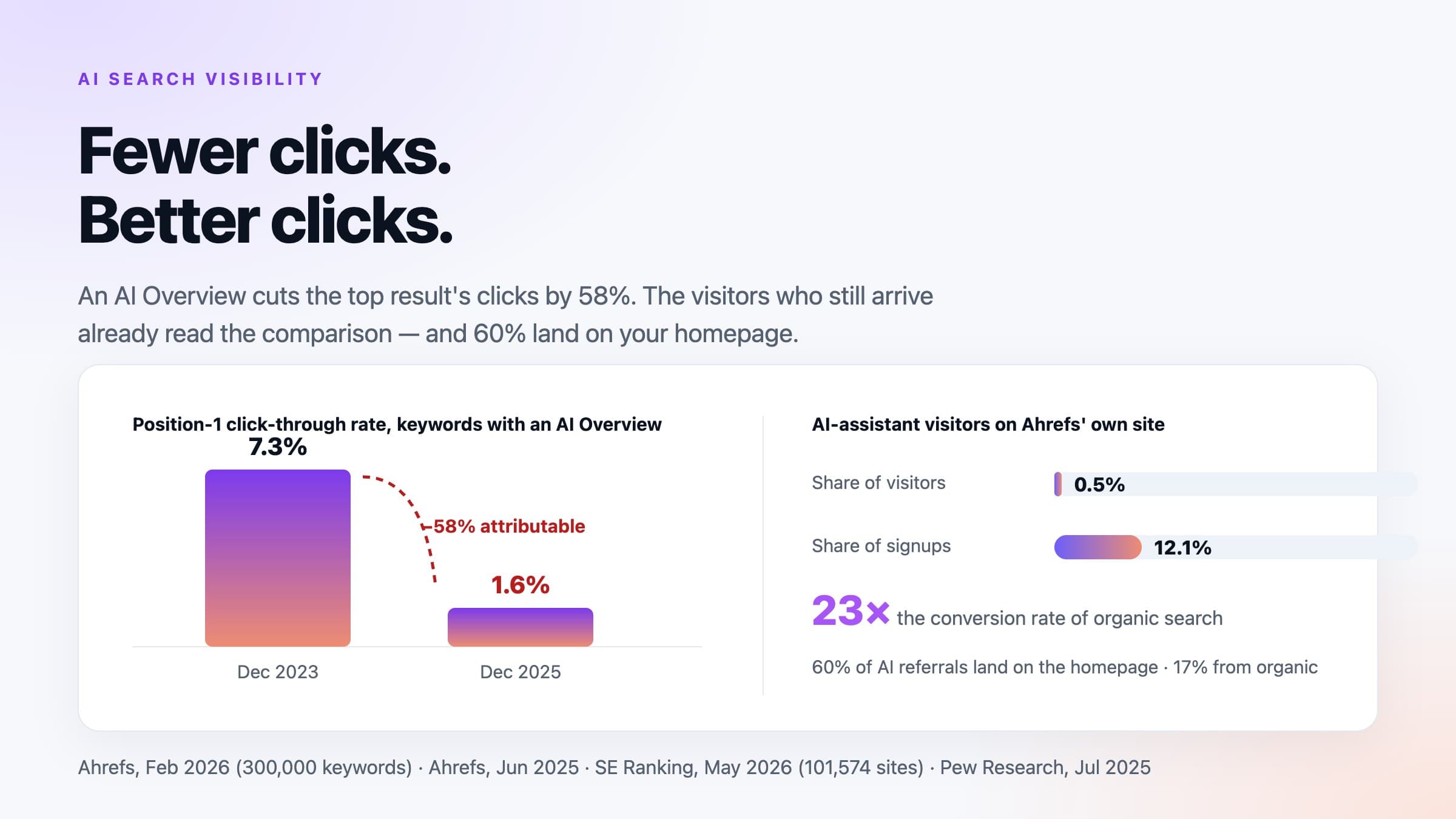
Two numbers landed on my desk in the same week, from two studies I trust, and they appear to contradict each other.
The first: when Google shows an AI Overview, the click-through rate of the page ranking first drops by 58%. Not for weak pages — for the page that won. The second: on Ahrefs' own site, visitors arriving from AI assistants were 0.5% of traffic and 12.1% of signups. Twenty-three times the conversion rate of everyone else.
Both are true, and once you see why, most of the advice you've read about "AI SEO" starts to look like it was written for the wrong problem. The traffic is not disappearing so much as being filtered. What comes out the other end is smaller, better, and lands on a different page than you expect. This is what the data says, and what we changed on our own site because of it.
What changed in May, and why it isn't going back
At I/O on 19 May 2026, Google said AI Mode had passed one billion monthly users, with queries "more than doubling every quarter since launch", and put Gemini 3.5 Flash in front of all of them as the default model. The search box itself was rebuilt for conversational prompts. Google's line is that you will "continue to get a range of results from Search, just like you do today". The word doing the work in that sentence is range.
For a business owner the practical version is simpler. A growing share of the people who used to see ten blue links now see a paragraph with three to five citations tucked into it, and a follow-up box. Some of them click through. Most don't. And the ones who do behave differently from the visitors you had in 2023.
How much of the traffic actually goes
The cleanest measurement is Ahrefs', updated in February 2026: 300,000 keywords from Google Search Console data, half with AI Overviews and half without, comparing December 2023 to December 2025. Because both groups declined over the period, they can separate the general drift from the AI Overview effect itself.
The raw numbers are stark. For keywords with an AI Overview, position-one CTR went from 7.3% to 1.6%. For keywords without one, it went from 7.6% to 3.9%. The gap between those two declines is the AI Overview effect, and it fades with position: −58% at one, −51% at two, −46% at three, −19% at ten. Ranking first now matters less than it did, in the one place it used to matter most.
Pew's panel study gets at the same thing from the user's side. 900 US adults, every Google search they ran in March 2025 — 68,879 of them. On pages with an AI summary, people clicked a traditional result in 8% of visits, against 15% without. They clicked a link inside the summary in 1% of visits. And they simply ended the session more often: 26% versus 16%.
Two details from Pew matter more than the headline. First, only 18% of searches produced a summary at all — but 60% of searches that began with a question word did, and 53% of searches with ten or more words, against 8% of one- or two-word searches. The longer and more specific the question, the more likely the answer arrives without a click. Second, 88% of summaries cited three or more sources. Being cited is common. Being clicked from a citation is rare.
The visitors who still arrive are worth more
This is the half of the story that the "SEO is dead" pieces skip, and it's the half that pays.
Ahrefs looked at their own analytics in June 2025. AI assistants sent 0.5% of their visitors and produced 12.1% of their signups. Semrush's cross-topic estimate, from more than 500 marketing keywords, is that AI search visitors convert at roughly 4.4 times the rate of organic. The exact multiple depends entirely on the business, and a single company's signup data is a case, not a law. But the direction is consistent everywhere I've seen it measured, and the mechanism is obvious once stated: the assistant has already done the comparing. By the time someone clicks, they've read a synthesis of you against your competitors and decided you're worth a look. The click is the end of the research, not the start.
Then there's where they land. SE Ranking's May 2026 analysis of 101,574 websites found ChatGPT referrals hit their highest share yet — 0.32% of traffic globally, up 36.7% in a single month — and, more usefully, that 60% of AI-referred traffic lands on the homepage, against 17% from organic search. Organic search sends people to your blog post. Assistants send them to you.
For the first time in fifteen years, your homepage is a landing page again. Most homepages have not been written as one.
What actually predicts being cited
Here's where the advice you've read falls apart. Most of it is repackaged SEO: build links, raise your domain authority, publish more. The largest correlation study I know of says that's the weakest lever available.
Ahrefs took 75,000 brands and measured how often each was mentioned across millions of AI responses in ChatGPT, Google AI Mode and AI Overviews, then correlated that against everything they could measure about the brand. Spearman correlations, so treat these as rank-order strength, and the usual disclaimer applies: correlation isn't causation.
Read the order. The three strongest signals — YouTube mentions at around 0.74, branded web mentions at 0.66 to 0.71, branded anchor text at 0.51 to 0.63 — are all about your name appearing in places the model reads. Domain Rating sits at 0.27 to 0.33. Backlink count is weaker still. Two to three times weaker than mentions.
That is a different game from the one most agencies are still selling. A link from a site nobody names you on is worth less to a language model than a paragraph on a forum where someone recommends you by name and explains why. The models learned who you are from text about you, not from anchors pointing at you.
The other finding worth knowing: the three platforms largely agree. AI Overviews and AI Mode correlate at 0.82; AI Mode and ChatGPT at 0.77. Ahrefs' phrase is that "the same big players tend to dominate, just through different paths". You don't need a ChatGPT strategy and a Google strategy. You need to be legible as an entity, and the platforms converge.
What this means for a small business site
I'll take these in the order I'd spend money on them.
1. Rewrite your homepage as a landing page
Sixty percent of AI referrals land there. Someone has just read a summary that says "Leet Force, a software agency in Islamabad that builds custom web platforms and AI intake automation for US and European clients" — and they arrive expecting the page to confirm it in the first screen. Most homepages open with a slogan. Ours did. Now the first heading says what we do, for whom, and the next line says where. If the assistant's description and your first screen disagree, you lose the visitor the assistant qualified for you.
2. Be the same entity everywhere
Models reconcile you across sources. The same company name, the same description of what you do, the same city, the same founders, the same phone number, on your site, your Google Business Profile, LinkedIn, Clutch, GitHub, and every directory that lists you. Then say it in structured data — an Organization with sameAs links to those profiles, a Person for each named author with a real job title and bio, Service entities for what you sell. This is unglamorous and it is the single highest-leverage piece of technical work, because it converts a pile of mentions into one confident entity.
3. Get named where the models read
This is the "off-site" half, and it's the half the correlations are pointing at. In rough order of what the data supports: YouTube (a walkthrough of your work, a founder talking about a real project, a client interview), review platforms and directories in your category, partner and client sites that name you, industry press, and communities where your customers ask questions. None of this is new. What's new is that a mention with no link now counts, and a link with no mention barely does.
4. Publish pages that answer one question completely
Pew's finding — 60% of question-form searches get a summary, 88% of summaries cite three or more sources — means the citation slots exist for the pages that answer the question best, with numbers, dates, named sources and a clear position. A 400-word "ultimate guide" that hedges every paragraph will not be cited over a page that says "here are the five figures, here is where each came from, here is what we'd do". Every post on this blog now follows that rule; it's why they have named authors, publication dates and primary citations rather than "studies show".
5. Make the page cheap to read by a machine
Server-rendered HTML, not content that only appears after JavaScript runs. Real headings in a real hierarchy. Tables for anything tabular. Dates on the page and in the metadata, kept honest. A sitemap whose lastmod only changes when the content does, because Google has said it stops trusting the field otherwise. Fast enough that a crawler on a budget finishes the page. These are the same things that have always mattered; the difference is that a model reading your page has less patience than Googlebot ever did.
6. Use the one lever Google handed back
In May, Google let readers mark a site as a Preferred Source across Search, Discover and News; by August there was an embeddable button. Google's figure is that people are "twice as likely to click through to a preferred source when available", and 345,000 sources had been selected by May. For a publisher this is essential. For a business site it is a small, free lift with your existing audience — ask your customers and newsletter readers to add you.
How to measure it, honestly
Three things, none of which need new tooling.
- Search Console impressions against clicks. If impressions hold or rise while clicks fall, you're being read inside summaries. That isn't nothing; it's brand exposure at zero cost. But track it separately from the clicks so you don't mistake one for the other.
- Referral traffic from AI assistants in GA4. Filter session source for
chatgpt.com,perplexity.ai,copilot.microsoft.com,gemini.google.com. It will be small — SE Ranking's global figure is a third of a percent. Look at conversion rate, not volume. - Ask the assistants directly. Monthly, ask ChatGPT, Gemini and AI Mode the ten questions a customer would ask before hiring you, and record whether you're named and what they say. It's crude and it's the only view of the thing you're actually optimising.
What we changed on our own site
This isn't theory; I'm writing it because we just went through it. In the past fortnight we ran a full audit on leetforce.co and the findings mapped onto the data above almost exactly. Our homepage title was a slogan. Our H1s said "Portfolio" and "Blog". Three posts had no contextual inbound links. Every page had a modified date of "now" in the sitemap. And two rendering decisions — a splash overlay and heroes that faded in from invisible — meant Google's speed measurement never saw our content at all; the only element it recorded as the largest paint was the 140-pixel header logo.
All of it is fixed, and the largest-paint time on the homepage went from 8.0 seconds to 3.6 under mobile throttling. I mention the number not because it's good — it isn't yet — but because the same audit process is what I'd recommend to anyone: measure, find the thing that's actually wrong, fix that, and don't touch the other forty things until it's done.
What I wouldn't do
Don't block the crawlers reflexively. Some publishers are blocking GPTBot and friends in robots.txt on principle. If you sell content, that's a real trade-off. If you sell a service, you are opting out of the one channel that sends buyers who've already decided.
Don't chase volume. The models are not counting your pages. Ahrefs' correlation for site page count was under 0.2. Fifty thin articles about "best software company in [city]" make you less legible, not more.
Don't buy "GEO" as a separate product. Every genuine lever above is either an SEO fundamental done properly or brand-building done properly. Anyone selling a proprietary AI visibility trick is selling the same thing under a new name, and the "twice as likely to click" figure came from Google, not from a vendor.
The traffic that's leaving was mostly never going to buy anything. The traffic that's arriving has already read the comparison. Build the site for the second group.
Frequently asked questions
How much traffic do Google AI Overviews actually take from a website?
Ahrefs compared 300,000 keywords in Google Search Console data between December 2023 and December 2025. For keywords showing an AI Overview, the click-through rate of the top-ranked page fell from 7.3 percent to 1.6 percent, against 7.6 to 3.9 percent for keywords without one. The effect attributable to the AI Overview itself is a 58 percent reduction at position one, 51 percent at position two, 46 percent at three and 19 percent at ten. Pew's panel study found users clicked a traditional result in 8 percent of visits when a summary appeared versus 15 percent without, and clicked a link inside the summary in just 1 percent of visits.
Do visitors from ChatGPT and other AI assistants convert better?
In every measurement we have seen, yes, though the multiple varies by business. Ahrefs found AI assistants sent 0.5 percent of visitors to their own site but produced 12.1 percent of signups, roughly 23 times the organic conversion rate. Semrush estimates AI search visitors convert at about 4.4 times the rate of organic visitors. The likely reason is that the assistant has already done the comparison before the click, so the visitor arrives with a decision mostly made. SE Ranking's data on 101,574 websites also found 60 percent of AI-referred traffic lands on the homepage, against 17 percent from organic search.
What makes an AI assistant cite or recommend a business?
The largest correlation study, Ahrefs' analysis of 75,000 brands across ChatGPT, Google AI Mode and AI Overviews, found the strongest predictors of being mentioned were off-site brand signals: YouTube mentions at around 0.74 Spearman correlation, branded web mentions at 0.66 to 0.71 and branded anchor text at 0.51 to 0.63. Domain Rating sat at 0.27 to 0.33 and backlink count was weaker still. The practical reading is that being named and described consistently in places the models read matters two to three times more than link building, and that the three platforms largely agree on which brands to surface.
Should a small business site block AI crawlers like GPTBot?
Not if you sell a service. Blocking makes sense for publishers whose content is the product, because the assistant substitutes for the visit. For a business that wants enquiries, the assistant is a qualification step that sends fewer visitors who are far more likely to buy, and blocking it removes you from the comparison entirely. Keep the site crawlable, server-rendered and consistent about who you are, and measure AI referrals separately in GA4 by filtering session source for chatgpt.com, perplexity.ai, copilot.microsoft.com and gemini.google.com.
Is generative engine optimisation different from SEO?
The name is new; the levers mostly are not. Every factor the data supports is either an SEO fundamental done properly, such as server-rendered pages, real heading structure, structured data for the organisation, authors and services, honest dates and fast loading, or brand-building done properly, such as being named on YouTube, review platforms, partner sites and industry press. Google's Preferred Sources feature, which it says makes people twice as likely to click through to a chosen source, is a free additional lever for sites with an existing audience. Anyone selling a proprietary AI visibility trick is selling those same things under a different label.
Related Posts
The Website Redesign Checklist We Actually Use With Clients
Most redesigns fail for the same reason: someone changed the paint job and called it strategy. Here's the audit, IA, and launch checklist that keeps a redesign from becoming a prettier version of the same problems.
The 5-Minute Rule Isn't From Harvard, and the Detail Everyone Drops Is the Useful One
21x more likely to qualify at five minutes than thirty. The number is real, the attribution is wrong, and the shape of the curve — not the speed — is what tells you how much engineering the problem deserves.
Offshore Development Rates by Country in 2026: What the Hourly Number Hides
Pakistan, India, the Philippines, Poland, LatAm — the published ranges overlap so much that country is doing less work in your decision than you think. What a $30/hour engagement actually costs, and the three cases where I'd tell you to hire someone else.