
Offshore Development Rates by Country in 2026: What the Hourly Number Hides
Pakistan, India, the Philippines, Poland, LatAm — the published ranges overlap so much that country is doing less work in your decision than you think. What a $30/hour engagement actually costs, and the three cases where I'd tell you to hire someone else.

Someone emailed me last month with a spreadsheet. Four columns: country, hourly rate, developers available, English score. They'd built it from a dozen agency blog posts and wanted to know whether the numbers were right before taking it to their board.
The numbers were roughly right. The spreadsheet was still going to lead them to the wrong decision, because the hourly rate is not the price and every one of those blog posts — including, I should say plainly, the ones written by agencies like mine — has a reason to quote the number that flatters it.
So here is the version I'd want if I were buying instead of selling: what the published ranges actually say, what they leave out, the one variable with peer-reviewed evidence behind it, and the cases where I'd tell you not to hire us.
What the published rates say
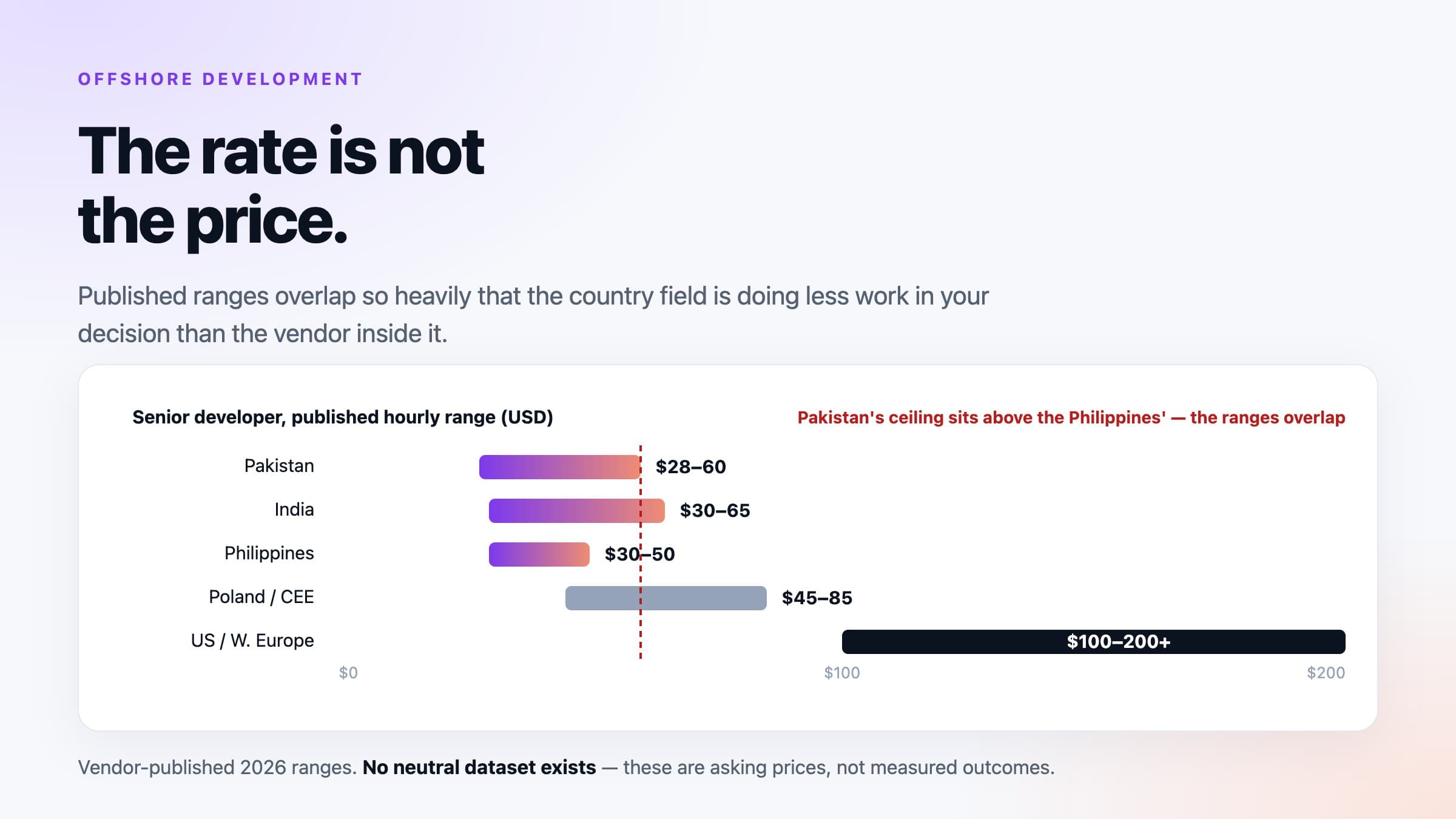
Start with the honest caveat. There is no authoritative dataset for offshore development rates. No government publishes it, no academic tracks it. Every range you'll find, including the one below, is compiled by firms that sell development services in one or more of these countries. Treat them as the market's self-reported asking prices, not as measurements.
The first thing to notice is how much the ranges overlap. Pakistan's top ($60) is above India's bottom ($30) and above the Philippines' top ($50). A "$30/hour country" and a "$60/hour country" are frequently the same country. Which means the country choice is doing far less work in your decision than the vendor choice inside it — and almost every comparison article is built the other way round.
The rate is not the price
Here is the arithmetic that spreadsheet was missing. Take a quoted $30/hour and follow it through a real engagement:
| What you add | Why | Effect on effective rate |
|---|---|---|
| Quoted rate | The number on the proposal | $30.00 |
| Your own coordination time | Someone on your side writes specs, reviews, answers questions. At 20% of a $120k salary against a 3-person team, that is real money. | +$4–7 |
| Rework | The industry-wide variable. A team that ships right the first time at $45 beats one that needs two passes at $30. | +$0–15 |
| Non-overlapping hours | A question asked at 4pm your time answered at 9am theirs is a lost day. Days become weeks. | Schedule, not rate |
| Knowledge that walks | Churn on the vendor's side, re-onboarding on yours. | +$2–5 |
The realistic all-in number for a nominally $30/hour engagement is somewhere between $35 and $50 depending almost entirely on rework and communication, not on geography. I've watched a $22/hour team cost more than a $55/hour team on the same scope, and the mechanism was not exotic: the cheaper team built what was asked rather than what was meant, twice.
You are not buying hours. You are buying the number of times something has to be built before it is right. Nobody prices that, and it dominates the total.
The one variable with real evidence behind it
Almost everything in the offshore debate is anecdote. Time zones are the exception, and the finding is more interesting than the folklore.
Fang, Choudhury and Chauvin, published in Organization Science in 2024, analysed communications records — scheduled meetings, unscheduled calls, instant messages and email — for more than 12,000 employees at a Fortune 100 multinational. They used daylight saving transitions as a natural experiment, which is what makes this causal rather than correlational: the same people, the same teams, the same work, with an hour of overlap added or removed by the calendar.
A one-hour increase in temporal distance reduced synchronous communication by 11%. That's the real number, and it is worth stating clearly because a figure of "37%" circulates widely online and is not what this study found.
Two things follow, and they point in opposite directions.
The first is that 11% is smaller than you'd expect. The authors note that losing an hour represented a 19% loss of overlapping business hours, so people are partially absorbing the gap rather than simply communicating less. Distance is not as destructive as the nearshore pitch implies.
The second is how they absorb it: time shifting. People work outside their normal hours to keep the collaboration alive. The study found this was most common among those with strong collaborative relationships and non-routine work — that is, your best people on your most important projects. And the burden fell unevenly: women, and employees in jurisdictions with stricter working-hours rules, were less likely to shift.
That reframes the question. Offshore time zones work, and they work because somebody is eating the difference at 7am or 10pm. When you evaluate a vendor, the honest question isn't "do you cover our hours?" — everyone says yes. It's who on your team is doing the shifting, whether it's the same two people every time, and whether that's survivable for two years rather than two months.
Country by country, without the sales pitch
India
The largest pool by a wide margin, the most mature vendor market, and the only one where you can buy from a firm with 200,000 employees if that's what your procurement process needs. The variance is the issue: the same published range covers world-class product engineering and body-shop staffing. India is the safest choice when you have the capability to evaluate vendors properly, and the riskiest when you don't, because the market is large enough to supply exactly what you're able to detect.
Philippines
The strongest English and the easiest cultural fit for US companies; the gap between what someone says in a meeting and what they mean is narrowest here. The senior engineering pool is smaller than India's or Pakistan's, and the market's centre of gravity is in support, back office and BPO rather than product engineering. Excellent for teams where communication load is high and the engineering is conventional.
Poland and Central Europe
Roughly twice the South Asian rate, and for some buyers that is the right trade. You get an EU jurisdiction, GDPR as a native assumption rather than a request, contract enforcement in a familiar legal system, and one to two hours from the UK. If your data is regulated or your client base is European enterprise, the premium buys away real risk. If your project is a marketing site, it does not.
Latin America
The nearshore answer for US companies, and the value is almost entirely the clock. A full overlapping working day means the Organization Science problem simply doesn't arise: nobody time-shifts, questions get answered inside the hour, and iteration speed is closer to an in-house team. For discovery-heavy work with changing requirements, that is worth the premium over Asia. For well-specified work, it usually isn't.
Pakistan — including where I'd steer you elsewhere
This is where I have the obvious conflict, so let me be concrete rather than enthusiastic.
The market is real and growing: IT exports hit a record $4.6 billion in FY2025-26, up 21% on the year, per State Bank of Pakistan balance-of-payments data reported by The Express Tribune, with freelancer earnings crossing $1 billion for the first time. That supports genuine specialists. It also gives cover to a very large number of shops selling the same WordPress theme under different names, which is the actual risk you're managing.
There's a shift worth knowing about too. P@SHA, the industry association, reports entry-level hiring at major firms down around 25%, with employment among developers aged 22–25 falling nearly 20% since 2024, attributed to AI adoption. Whatever you think of that as policy, as a buyer it means the junior-heavy pyramid that made the cheapest quotes possible is thinning. Expect the floor of the range to rise.
I'd point you somewhere else in three cases, and I mean this literally rather than as false modesty:
- You're on the US West Coast and your requirements are still moving. Nearshore. You need the overlap more than you need the saving, and anyone in Pakistan promising you a full Pacific working day is promising that a specific person will never see their evenings.
- Your data is regulated in Europe and your counsel is nervous. A Polish or Portuguese team inside the EU removes an argument you'd otherwise have to win repeatedly. We can work to GDPR and sign the paperwork, but we can't move jurisdiction.
- You need fifty engineers next quarter. That's a large-vendor problem. India, or a staffing firm. We're not it, and a small studio saying yes to that is telling you something about its judgement.
What's left is the case we're actually good at: a defined product or platform, a team of three to eight, a buyer in the Gulf, the UK or Europe where the clock is on our side, and enough scope clarity that the work rewards engineering rather than hand-holding.
How to evaluate a vendor in any of these countries
These questions distinguish the good from the plausible far better than the country field in a spreadsheet does.
- "Show me something you built that's still running, and tell me what broke." Everyone has a portfolio. The second half is the test — a team that can't name a failure either hasn't shipped or won't tell you.
- "Who exactly is on my team, and what else are they on?" Named people with a percentage. The classic failure is the senior engineer who appears in the pitch and is 10% allocated after signing.
- "Which hours will each of them be online, and whose evening does that use?" The Organization Science question, asked plainly. Anyone who can answer it honestly has thought about retention.
- "What happens to the code if we stop working together?" Repository ownership, credentials, documentation, deployment access — settled in the contract, not on trust.
- Pay for a small, real piece of work first. Two weeks, scoped, paid at full rate. No reference call, portfolio or interview predicts a working relationship as well as a small one. If a vendor won't do a paid trial, that is the answer.
What I'd actually put in the spreadsheet
Delete the "hourly rate" column and replace it with three: hours of overlap with your team, who on their side is shifting to get it, and the total of the paid trial. The first two are the only country-level variables that are reliably different. The third is the only measurement you'll have that wasn't written by someone selling.
Rate matters least of the four things in front of you, and it is the only one most buyers actually compare. If you want the fuller version of the vendor-selection half of this, we wrote it up separately in hiring a web development agency in Pakistan, and the contract-model question — who carries the risk when the estimate is wrong — is in fixed price vs time and materials.
Frequently asked questions
What are offshore software development rates by country in 2026?
Published 2026 ranges for senior developers put Pakistan at roughly 28 to 60 dollars an hour, India at 30 to 65, the Philippines at 30 to 50, Poland and Central Europe at about 45 to 85, and Latin America at about 45 to 75, against 100 to 200 dollars or more for a US or Western European agency. No neutral dataset exists for these figures; every published range is compiled by firms that sell development services, so they represent asking prices rather than measured outcomes. The ranges also overlap heavily, which means the vendor you choose inside a country matters more than the country itself.
Why does the quoted hourly rate understate the real cost?
Because rework and coordination are not in it. A nominally 30 dollar an hour engagement typically lands between 35 and 50 dollars all in once you add your own team's specification and review time, re-onboarding after churn on the vendor side, and above all the number of times work has to be built before it is right. A team that ships correctly the first time at 45 dollars routinely costs less in total than one needing two passes at 30. Non-overlapping hours add schedule cost rather than rate cost, because a question asked at the end of your day is answered at the start of theirs.
How much time zone overlap do you need with an offshore team?
More than the sales pitch implies, but less than nearshore vendors suggest. Fang, Choudhury and Chauvin, published in Organization Science in 2024, analysed communications for more than 12,000 employees at a Fortune 100 firm and used daylight saving transitions as a natural experiment. A one hour increase in temporal distance reduced synchronous communication by 11 percent, less than the 19 percent of overlapping business hours actually lost, because people absorb the gap by time shifting into their own evenings and early mornings. The practical question to ask a vendor is not whether they cover your hours but who on their side is shifting to achieve it, and whether that is sustainable over years.
Is Pakistan a good country for offshore development?
It is strong for a defined product or platform with a team of three to eight people and a buyer in the Gulf, the UK or Europe, where the working day genuinely overlaps. Pakistan's IT exports reached a record 4.6 billion dollars in FY2025-26, up 21 percent, which supports real specialists, though the same market contains many firms reselling identical templates. It is the wrong choice in three cases: a US West Coast client with moving requirements, where nearshore overlap matters more than the saving; regulated European data where an EU jurisdiction removes a recurring legal argument; and a need for fifty engineers next quarter, which is a large vendor problem.
How should you evaluate an offshore development vendor?
Ask to see something still running in production and what broke on it, since a team that cannot name a failure either has not shipped or will not tell you. Get named people with allocation percentages rather than a pitch team that disappears after signing. Ask which hours each person will be online and whose evening that uses. Settle repository ownership, credentials, documentation and deployment access in the contract rather than on trust. Then pay for a small, real, fully priced piece of work before committing; no reference call or portfolio predicts a working relationship as well as two weeks of actual work, and a vendor unwilling to do a paid trial has answered the question.
Related Posts
Hiring a Web Development Agency in Pakistan: What We Wish Every Client Knew
Pakistan has real design talent and a lot of noise around it. Here's how to tell a genuine studio from a template shop, what things should cost, and the questions to ask on your first call.
Fixed Price or Time and Materials? You're Choosing Who Owns the Tail Risk
The median software project lands on budget. The mean overruns by 80%. Same 4,677 projects. That gap is what your contract model is actually allocating, and almost nobody writing about this mentions it.
WhatsApp's Free Window Closed on 1 October 2026: What It Costs You Now
Service messages and in-window utility templates stopped being free on 1 October 2026. Inbound support setups took the biggest proportional hit. Here's how to work out your new bill and what to change now.